EVERYTHING About Scuba Certifications: Levels, Requirements, Experience…

Diving into the world of scuba isn’t just a thrilling experience; it’s also a learning journey. If you’ve ever wondered what steps you need to follow to get different scuba certifications, or what being certified actually means, you’re in the right place.
In this post, we’ll guide you through the various certifications, how to get them, and what you can do with them, whether you’re taking your first steps or you’ve been diving for a while and are looking to advance.
We’re going to break down the levels, specialties, requirements, and more.
Shall we start?
What Are Scuba Certifications and What Are They For?
You might have thought about it before, even if you weren’t entirely sure: do you need some kind of “license” to dive? Is a certification mandatory? Or is it enough to just put on a tank and go with the flow?
These questions are more common than you think, especially if you’ve already had some initial contact with the world of diving and have been bitten by the bug to go a step further.
The reality is that certifications in this sport not only exist, but they are an essential part of any diver’s path. They are what allow you to learn to move safely underwater, understand your environment, use your gear correctly, and know how to act if something doesn’t go as expected.
It’s not just a legal matter or about accessing certain activities; it’s about being prepared. Prepared to enjoy yourself more, go further, and do it all with confidence.
And that’s where the famous scuba certifications come in. They are what mark your progress and, in many cases, what push you to discover skills you didn’t know you had.
What Are the PADI Certifications and How Can You Get Them?
If you’ve started taking an interest in the different levels of diving, you’ve probably come across the name PADI more than once. And it’s no coincidence. PADI (Professional Association of Diving Instructors) is the world’s most recognized diver training organization.
It has been training millions of people in over 180 countries for decades, and its system is designed for you to learn safely, progressively, and at your own pace.
Below, we show you how that path works and what you can expect at each stage.
PADI Discover Scuba Diving
If you’re curious about diving but aren’t sure if you want to commit to a certification, there’s a perfect option for you. PADI Discover Scuba Diving is a guided experience that lets you try diving in a simple and safe way, without needing prior experience or extensive theoretical training.
This experience is also often called a discovery dive and, unlike a course, it does not grant a certification. However, it does teach you the basics of scuba diving with autonomous equipment and allows you to do a real dive in the ocean (or a pool) under the direct supervision of an instructor.
Breathing underwater, moving with the gear, and exploring the underwater world for the first time is, for many, the starting point of something bigger.
- Duration: approx. 3 hours (can be 1 to 2 dives)
- Minimum age: 10 years old
- Prior experience: not required
PADI Open Water Diver
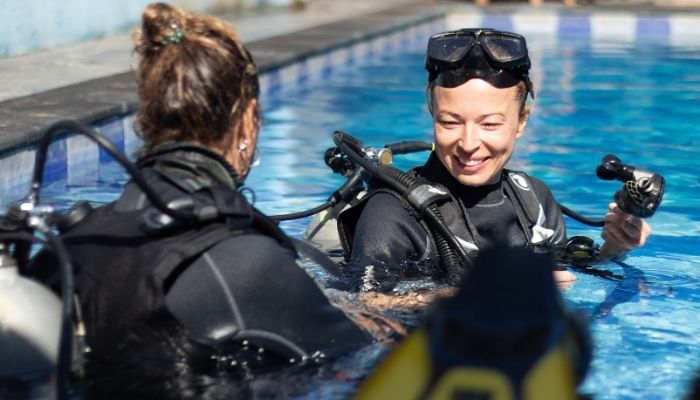
This is where the journey really begins for most. This certification allows you to dive to a depth of 18 meters (60 feet) anywhere in the world, without needing to be accompanied by an instructor, as long as you go with a certified buddy.
The course combines theory (taught in person at our center), practical sessions in confined water, and several dives in the ocean.
You learn to plan your dives, handle your gear, control your buoyancy, and resolve minor unexpected issues underwater.
It is one of the most popular among our diving courses in Lanzarote and the true entry pass to the world of recreational diving.
- Duration: 3 to 5 days
- Minimum age: 10 years old
- Prior experience: not required
Advanced Open Water Diver
If you already have your Open Water and want to keep learning, this is your next step. The Advanced isn’t a theory-heavy course, but one of experience: you do five adventure dives in open water under the supervision of an instructor, each focused on a different specialty.
The two mandatory ones are deep diving (up to 30 meters/100 feet) and underwater navigation. You can choose the other three based on your interests, such as buoyancy, night diving, or wreck diving.
With this course, you gain confidence, technique, and access to more challenging environments.
- Duration: 2 to 3 days
- Minimum age: 12 years old
- Prior experience: must have Open Water Diver certification
Rescue Diver
Here the perspective changes: it’s no longer just about you, but about knowing how to act if someone else needs it. This course trains you to prevent, detect, and manage emergency situations both on the surface and underwater.
It includes theory, practical exercises, and rescue simulations. It also requires prior first aid training. Many divers agree that this is the course that made them grow the most.
Additionally, it marks a turning point if you’re interested in moving toward professional levels later on.
- Duration: approx. 2-3 days
- Minimum age: 15 years old
- Prior experience: Advanced Open Water + first aid training
Want to Specialize in Diving? Here Are Some Options…
You already have your diving certification and you’re wondering: what now? Well, now the fun begins: specializing.
One of the most exciting things about the world of diving is that you never stop learning. As you dive into new experiences, you discover that there are courses that improve your technique, expand your limits, and prepare you for more demanding scenarios.
Here we tell you about two of the specialties that we teach the most at our diving center in Lanzarote because, honestly, they make a difference:
Enriched Air Diver (Nitrox)
Surely you’ve come out of the water before and thought, “What a shame I have to go up already!” Well, that’s where enriched air, also known as Nitrox, comes in.
This course teaches you to dive using a mix with a higher oxygen concentration and less nitrogen than traditional compressed air. And what does that mean for you?
- Less nitrogen saturation in the body, which reduces the risk of decompression sickness.
- More bottom time (especially on repetitive dives).
- If you do more than one dive a day, you’ll be able to extend your enjoyment on each one, which is very useful during diving trips.
The best part is that it doesn’t require mandatory water sessions, and it gives you a technical advantage that changes the way you plan and enjoy every dive.
In this post, we tell you all about the experience of diving with nitrox.
Deep Diving
If you’ve ever felt that tingle when looking at the endless deep blue of the sea, this course is for you.
The Deep Diver specialty prepares you to go down to 40 meters (130 feet), the limit of recreational diving. But this isn’t just about depth. It’s about doing it safely, consciously, and with total control. You learn about:
- How pressure affects your body and your gear.
- Recognizing symptoms of narcosis and how to act.
- Planning deeper dives.
- Using dive computers, safety stops, and gas management.
This course is a leap forward as a diver. You don’t just go deeper: you go better prepared.

And you, which one would you start with?
The most beautiful thing about specialties is that you can choose based on what catches your attention most, your diving style, or the challenges you want to take on.
But they aren’t the only ones. If you’re into the adrenaline of something different, you can try other options like night diving or wreck diving.
And there’s more: underwater navigation, buoyancy, underwater photography, marine life identification… the list is long!
The important thing here is to choose those that motivate you, that help you feel more comfortable, more prepared, or simply happier underwater.
And if you already know which specialty or certification might interest you, at Titan Blue Divers we are ready to guide you. If you have questions, contact us!


