Surface Interval in Scuba Diving: Tips and Mistakes You Should Avoid

Ever wondered what happens inside your body between dives? That time at the surface, which many see as just a simple break, is actually one of the most critical moments in all of scuba diving.
The surface interval in scuba diving not only shapes how much you can enjoy your time underwater, but it also determines your safety and the overall quality of each experience.
Understanding how it works, why it matters so much, and what you can do to make the most of it will help you dive with more confidence, greater peace of mind, and above all, the certainty that each dive will be better than the last.
What Is a Surface Interval in Scuba Diving?
Picture this: you just got out of the water after an amazing dive. You’re on the boat, taking off your fins, and already thinking about the next one. That time in between isn’t just for taking in the view—it’s called a surface interval.
During this time, your body off-gasses the nitrogen that built up while you were underwater.
Because of that, this rest is directly linked to your safety. When you respect it, you lower the risk of issues like decompression sickness.
That’s why, every time you dive, the surface interval is an essential part of your dive plan. Whether you use dive tables or your dive computer, the key is knowing that this downtime is what lets you enjoy every dive with complete peace of mind.
Why Is It So Important?
By now you know that a surface interval isn’t just “downtime.” So the real question is, what happens if you don’t respect it?
When you dive, breathing compressed air causes nitrogen to dissolve into your body tissues.
If you head back down too soon, that gas won’t have had enough time to clear and can form bubbles inside your body. Those bubbles are what cause the condition we mentioned earlier: decompression sickness, one of the most serious risks in scuba diving.
The interval acts as a safety cushion: it gives your body the time it needs to gradually off-gas nitrogen and prevent complications. That’s why the deeper and longer your dive was, the more critical this wait time becomes.
Alright, So How Long Should My Surface Interval Be?
While it’s typical to wait at least 1 hour, it’s not just about the duration itself, but how you plan it out.
Dive computers and dive tables calculate exactly how long you need to wait based on your previous dive profiles. That data is what separates a safe dive series from one where things can quickly become unpredictable.
Tips to Make the Most of Your Surface Interval
Knowing how essential this break is, the next logical question is: what can you do during this time to make the most of it?
Stay hydrated and eat light
Hydration is probably the most repeated piece of advice in scuba diving, and for good reason. A dehydrated body eliminates nitrogen more slowly, increasing your risk of decompression issues. Drinking water or electrolyte drinks helps your body recover much better between dives.
When it comes to snacks, go for easy-to-digest foods like fruit or nuts. Skip heavy or greasy meals, since your body needs that energy to rebalance, not to digest a heavy load.
Keep warm or cool depending on the weather
After a dive, even in warm waters, it’s normal to feel gradually chilled. Losing body heat doesn’t just affect your comfort—it can also slow down your recovery.
That’s why it’s a good idea to keep a dry towel handy, a windbreaker, or even a cap if you’re diving under the strong Lanzarote sun. Matching your layers to the environment will ensure you start the next dive with more energy and less fatigue.
Check your gear before the next dive
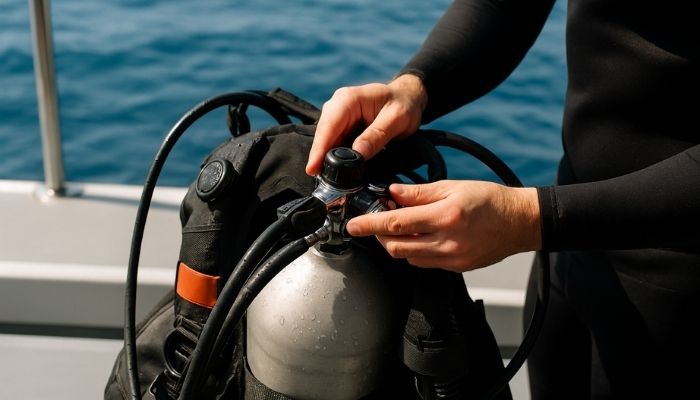
The surface interval is the ideal time to spot and fix minor equipment issues. Make sure your regulator is breathing smoothly, check your tank pressure, adjust your weights, or tweak your BCD fit.
Taking care of these checks calmly at the surface prevents headaches underwater and lets you focus on enjoying the dive.
Check your dive computer or tables
While personal experience goes a long way, you shouldn’t rely solely on how you feel.
Your dive computer and decompression tables are your objective tools to know exactly how long you need to wait before heading back down.
The computer tailors its calculations to your specific dive profile, while tables give you a reliable guide if you prefer a traditional approach.
How to Optimize Your Surface Interval?
So far, we’ve covered what to do during your break to take care of yourself and get ready. But there’s another level: optimizing that time so your next dive is even safer and more rewarding.
Here are a few factors that experienced divers will definitely recognize:
- Diving with Nitrox (enriched air)
This mix has less nitrogen than standard air, which means your body absorbs less gas during your dive. The payoff: shorter surface intervals and longer bottom times. It’s especially great on trips with multiple dives a day.
📍 Just keep in mind that to dive with enriched air, you’ll need to get certified through our PADI Enriched Air Nitrox course, where you’ll learn how to handle it safely and factor it into your dive planning.
If you’d like to explore this topic a bit more before signing up, check out our helpful post: What Is Nitrox Used For in Scuba Diving? Is It Safe?
- Tailoring your plan to your level and experience
An Open Water diver doesn’t follow the same parameters as someone with an Advanced or Deep Diver certification. Depth limits and interval management vary, and your dive computer reflects that.
Knowing how to interpret those numbers is what makes the difference between winging it and diving with complete confidence.
- Staying consistent with your planning
Sticking to the times on your computer, logging your profiles, and understanding how they affect your body is the best way to grow as a diver. Over time, you’ll see that every choice you make at the surface directly impacts the quality and safety of your next dive.

Surface Intervals and Recreational Diving Limits
When talking about optimizing surface intervals, we also have to look at recreational diving limits. Ultimately, your depth and bottom time dictate how much nitrogen you absorb, and therefore how long you need to wait before descending again.
- The link between depth and wait time
The deeper you dive, the greater the pressure, and the more nitrogen your body takes in. That means your intervals need to be longer to compensate. An 18-meter dive isn’t planned the same way as a 30-meter one. - The role of certification
Diving courses set clear limits: for instance, Open Water divers have a recommended maximum depth of 18 meters, while Advanced divers can go down to 30 meters. These limits are directly tied to how surface intervals are calculated and how safety is managed for each dive profile. - The logic of progression
As you advance in your training, you learn to manage more variables: air consumption, time, depth, and of course, intervals. This allows you to plan more complex dives safely and confidently. In that sense, managing intervals is an ongoing part of your learning journey as a diver.
Got any questions? Drop us a line—we’re here to help!


